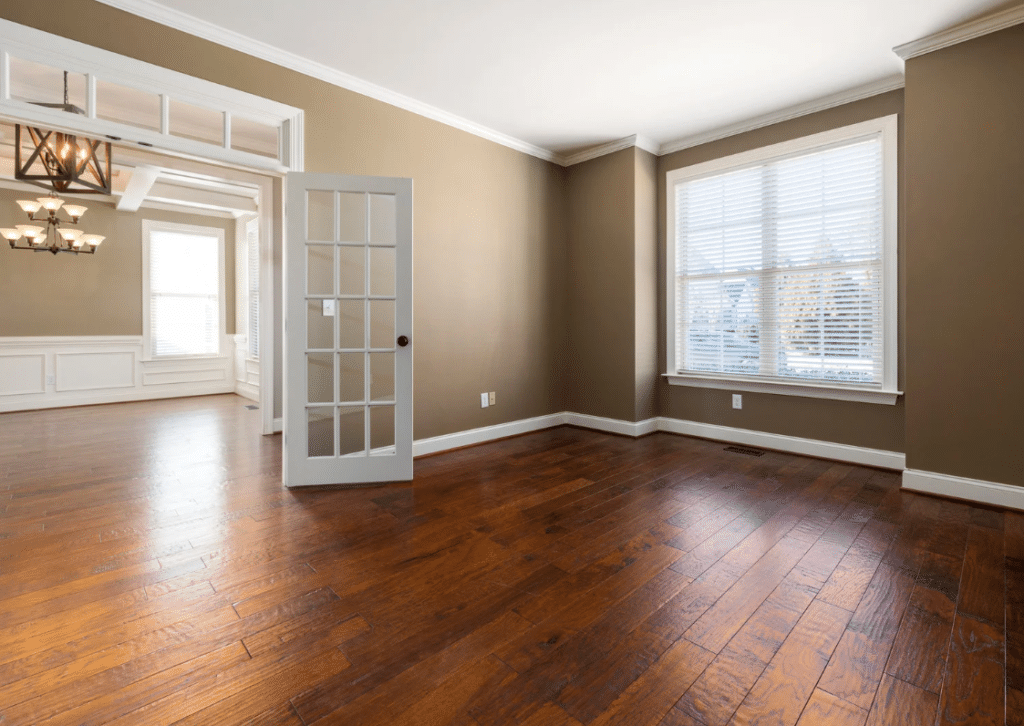

LVP vs. laminate flooring is one of the most common comparisons Front Range homeowners bring to us, and the honest answer is that neither product wins outright. Colorado’s specific conditions change the calculation: snowmelt tracked in from ski boots, indoor humidity that drops to roughly 15-20% in winter, intense UV at elevation, and the temperature swing between a heated living room and an uninsulated basement. Those variables determine which floor actually holds up, not which one looked better on the showroom floor.
This post walks through both products the way we’d explain them to a neighbor, including the rooms where each one makes sense and the rooms where one of them will fail you.
The Short Answer on Luxury Vinyl Plank vs. Laminate Flooring
LVP wins in any room with real moisture risk: basements, entryways, kitchens, mudrooms. Its polymer core doesn’t absorb water, so snowmelt and spills don’t become a replacement job. Laminate can be the smarter call in dry, lower-traffic rooms like bedrooms and living rooms, where scratch resistance matters and moisture isn’t a daily factor. Colorado’s climate, not the marketing materials, is what tips the decision.
What Is the Difference Between LVP and Laminate Flooring?
The difference between vinyl plank and laminate flooring comes down to what’s inside the plank. LVP (luxury vinyl plank) has synthetic materials: a polymer or stone plastic composite (SPC) core, a photographically printed wood-grain layer, and a transparent wear layer on top. Nothing in that stack absorbs water.
Laminate is a different construction. It has a high-density fiberboard (HDF) core, which is compressed wood fiber and resin. That HDF core can swell when moisture seeps into the seams or sits on the surface for an extended period. The photographic layer on top and the aluminum oxide wear layer protect against surface scratches well, but they don’t protect the core from water coming in from the sides.
Both products are floating floors installed with click-lock systems. Neither is glued or nailed to the subfloor. Both replicate the look of hardwood convincingly. The laminate wood flooring vs. LVP debate is really a question of what the core is made of, because that single structural difference drives almost every practical gap between the two products in Colorado homes.
What Is an SPC Core and Why Does It Matter?
SPC stands for stone plastic composite. It is a denser, more rigid version of a standard vinyl core, made from limestone powder and PVC rather than the wood-fiber blend used in laminate or the lighter foam-influenced construction in WPC (wood plastic composite) LVP. Because it is dense, SPC-core LVP expands and contracts very little as indoor humidity swings up and down.
That matters a lot in Colorado. Winter indoor humidity in many Boulder-area homes drops into the 15-20% range, and that dryness causes floating floors to shrink slightly and develop visible gaps. Standard laminate and WPC LVP are both more prone to that movement. SPC-core LVP handles those humidity swings with minimal dimensional shift, which is why we reach for it in Colorado installations where temperature and humidity vary significantly between seasons.
Waterproof Laminate vs. Vinyl Plank Flooring: What Those Claims Actually Mean
Waterproof laminate vs. LVP sounds like a direct comparison, but the two claims aren’t the same promise. Newer laminate products are marketed as water-resistant or even “waterproof,” and those labels apply primarily to the surface layer. If water sits on the face of the plank for a few minutes, a good laminate surface handles it. The problem is the HDF core underneath, which remains vulnerable once moisture works its way into the seams or sits at the edges.
LVP’s waterproof rating runs through the entire construction: the core, the edges, and the surface. It is waterproof core-to-surface, not just at the top layer. That distinction matters most in the rooms where water doesn’t arrive as a tidy spill you wipe up in 30 seconds; it arrives as snowmelt pooling at the door or condensation building under a kitchen sink.
When a homeowner tells us they’ve found “waterproof laminate,” our job is explaining what that claim actually covers. Waterproof laminate vs. vinyl plank is not an apples-to-apples comparison on moisture protection. The laminate surface resists water until it doesn’t, and the damage to the HDF core is typically irreversible. If you’re weighing these options for a moisture-prone room, our waterproof flooring options in Boulder page covers this in more detail.
LVP vs. Laminate Cost: What to Expect in Colorado
LVP vs. laminate cost is closer than most homeowners expect. Both products span a wide range depending on wear layer thickness, core density, and finish quality. Thicker wear layers and SPC cores push LVP prices higher. Higher AC ratings (the laminate industry’s scratch-resistance scale) push laminate prices up as well. The two products overlap significantly in the mid-range.
We don’t quote installed pricing here because Colorado market rates shift, and the right number depends on your rooms, your subfloor condition, and what product tier fits your household. Installed cost ranges for both products are typical installed cost range for LVP in Colorado, per square foot and typical installed cost range for laminate in Colorado, per square foot.
What we do tell homeowners is that the cheapest option per square foot isn’t always the cheapest option over time. A laminate installed in a basement that develops moisture issues within two years costs more than LVP installed once and maintained properly. The right product for the room is the one that costs less in the long run.
How Colorado’s Climate Changes the LVP vs. Laminate Decision
Most national flooring content treats moisture and durability as generic considerations. Colorado has specific ones, and they change the calculus.
- Dry winter air. Indoor humidity in Colorado homes regularly drops to approximately 15-20% in winter months. Floating floors contract at those humidity levels, and the seams between planks can open up visibly. SPC-core LVP handles this movement better than laminate, which has a wood-fiber core that is more reactive to humidity shifts. For a deeper look at how LVP performs in Colorado’s climate, we’ve covered that in a dedicated post.
- Snowmelt in entryways and mudrooms. On the Front Range, boots come inside wet from November through March. That’s not a spill situation; it is repeated standing water at the threshold, multiple times a day. LVP’s polymer core handles that without concern. Laminate’s HDF core does not.
- UV at elevation. Colorado’s high-altitude sun is more intense than what most product specifications are tested against at sea level. Both LVP and laminate can fade in west-facing rooms with significant sun exposure. LVP’s polymer construction is generally more tolerant of that intensity, though product quality matters. Cheaper LVP can soften or discolor under intense direct sun, so wear layer quality is worth checking.
- The temperature swings. The gap between a cold unheated basement in January and a heated living space above it can be significant. Rigid SPC-core LVP tolerates those temperature differentials better than laminate, which can cup, buckle, or gap when installed in spaces where temperatures fluctuate widely.
Room-by-Room: Which Flooring Wins in a Colorado Home?
The room determines the answer. Here’s how we think through it for Colorado households:
- Basements: LVP. Below-grade spaces carry moisture risk even when they seem dry: concrete subfloors wick humidity, and Colorado’s occasional wet spring weather raises basement moisture levels. The polymer core is the only sensible choice here. See our full breakdown on LVP for Colorado basements for specifics.
- Entryways and mudrooms: LVP. Snowmelt is a daily reality on the Front Range from late fall through early spring. Laminate can survive an occasional wet boot, but repeated standing water at the entry will work into the seams over time.
- Kitchens: LVP. Spills happen, dishwashers leak, and under-sink humidity is persistent. The polymer core handles all of it without swelling or warping. A quality laminate can work in a very low-moisture kitchen, but the risk profile is higher.
- Living rooms: Either can work. In a dry Colorado living room without significant sun exposure, a high-AC-rated laminate handles foot traffic well and can edge out LVP on scratch resistance at a similar price point. This is the room where laminate makes the most sense.
- Bedrooms: Laminate can be the better pick. Low moisture, low traffic, and laminate’s aluminum oxide wear layer holds up well. Price per square foot matters more in bedrooms, and laminate earns that comparison.
- Home offices: Either works. If you’re rolling a desk chair across the floor daily, laminate’s scratch resistance is a slight advantage, though LVP with a chair mat performs fine. Subfloor condition matters more here than the product choice.
LVP vs. Laminate Side-by-Side: Quick Comparison
Here’s the LVP flooring vs. laminate pros and cons breakdown in a single table:
| Feature | LVP | Laminate |
| Core material | Polymer/SPC | HDF wood fiber |
| Waterproof rating | Full construction | Surface layer only |
| Scratch resistance | Moderate to good | Very good to excellent (high AC rating) |
| Recommended rooms | Basements, kitchens, entryways | Living rooms, bedrooms, low-moisture areas |
| Response to dry Colorado winters | Minimal expansion/contraction (SPC) | Can contract and gap in very dry conditions |
| UV resistance | Generally stable | Varies by wear layer |
| DIY friendliness | Click-lock, beginner-friendly | Click-lock, beginner-friendly |
| Looks like real wood | Yes, photographically printed | Yes, photographically printed |
Chris’s Take: What We Actually Install in Colorado Homes
I bought a flooring store in Steamboat Springs in 2021, ran it for a few years, and sold it in 2024 before launching Right This Way Flooring in Boulder. In that time I installed and serviced floors across mountain and Front Range homes, and the pattern I kept seeing was the same: laminate in basements and entryways that had failed, usually within two to three years, because the homeowner or a previous contractor chose it based on price without thinking through the moisture picture.
My honest default for any Colorado room with real moisture exposure is LVP, specifically SPC-core LVP. Not because laminate is a bad product, but because the HDF core and Colorado’s conditions aren’t a great match in those spaces. I’ve seen it fail too many times to recommend it in a basement or a mudroom, regardless of how it’s marketed.
Where I do recommend laminate is in dry bedrooms and living rooms where scratch resistance matters and the homeowner wants to stretch their budget. A quality laminate with a solid AC rating holds up well in those rooms, and there’s no honest reason to push LVP if the conditions don’t call for it. Anyone telling you one product is always the answer is selling one product.
If you’re not sure which fits your specific rooms and subfloor, that’s the kind of question we sort out during a schedule of a free in-home consultation.
LVP vs. Laminate: Frequently Asked Questions
Which is better, LVP or laminate flooring?
Neither is universally better. LVP is the stronger choice in rooms with moisture exposure: basements, entryways, kitchens, and mudrooms. Laminate performs well in dry, low-traffic rooms like bedrooms and living rooms, where its scratch resistance is a real advantage. In Colorado specifically, the moisture and humidity conditions tilt the scale toward LVP in more rooms than most homeowners expect.
Is waterproof laminate the same as LVP?
No. When laminate is marketed as waterproof, that claim applies to the surface layer. The HDF core underneath remains vulnerable to moisture that seeps into seams or sits at the edges over time. LVP is waterproof through its entire construction: core, edges, and surface. The two products aren’t offering the same protection, even when labeled similarly.
Does LVP or laminate last longer?
Both can last 15-25 years with proper installation and appropriate room conditions. Longevity depends more on whether the product matches the room than on the product itself. LVP installed in a dry bedroom and laminate installed in a dry bedroom will both perform for a long time. Laminate installed in a basement won’t reach that lifespan regardless of product quality.
Which is easier to install, LVP or laminate?
Both use click-lock floating systems and are accessible for experienced DIYers. LVP is slightly more forgiving on subfloors that aren’t perfectly level because of its flexibility, particularly with WPC-core products. SPC-core LVP is more rigid and requires a flatter subfloor, similar to laminate. Neither requires glue or nails for a standard floating installation.
Which holds up better with pets?
Laminate edges out on scratch resistance for pet nails, particularly with AC4 or AC5 rated products. LVP is the better choice for accidents and spills. If your household has both concerns, the room matters: LVP in high-traffic or moisture-risk areas, laminate in dry bedrooms where scratch resistance is the main priority.
Can you install LVP or laminate over radiant heat?
Many LVP products are rated for radiant heat installations with manufacturer spec guidance. Most laminate manufacturers don’t recommend laminate over radiant heat, as the temperature cycling can cause the HDF core to expand and contract repeatedly, leading to premature failure with manufacturer spec guidance. Always confirm compatibility with the specific product’s installation guidelines before proceeding.
Still Deciding? Here Is the Honest Next Step
The framework is straightforward: moisture-prone rooms point toward LVP, dry low-traffic rooms can go either way, and Colorado’s specific climate conditions mean LVP is the right call in more rooms than most national guides will tell you. The subfloor, the room’s moisture history, and how your household actually uses the space all affect which product fits.
We work with homeowners across Boulder, Erie, Lafayette, Louisville, Broomfield, Niwot, Longmont, Superior, Westminster, and the broader Front Range. You can come see samples at our Boulder showroom, located next to McGuckin Hardware, or we can bring samples to you so you can see them in your actual light and space. There’s no pressure either way, and no one-size recommendation before we’ve seen the room.
To talk through your specific situation, schedule a free in-home consultation and we’ll take it from there.
Explore More Flooring Resources
If you’re still comparing options or want to dig into a specific category before deciding, these pages go deeper:
- Luxury vinyl plank flooring – our full LVP product selection
- Laminate flooring – laminate options and specs
- How LVP performs in Colorado’s climate – a detailed look at LVP performance across Front Range conditions
- LVP for Colorado basements – why we install LVP specifically in Boulder County basements
- Hardwood flooring – for readers cross-shopping real wood alongside LVP and laminate